Streak has built its website around one remarkably consistent idea: your CRM should work where your team already works, inside Gmail.
Across its homepage, product pages, pricing experience, signup flow, and even product onboarding, that positioning remains clear. Visitors can quickly understand what the product does, experience how it works, and choose between self-serve signup and sales-assisted conversion paths.
But strong product clarity doesn’t mean the conversion journey is without opportunities.
This teardown examines how Streak uses positioning, messaging, product experience, pricing, and conversion paths to move visitors toward signup and where stronger customer evidence and outcome-focused messaging could make that journey even more persuasive.
Who Should Read This Teardown?
This breakdown will be useful for SaaS founders, marketers, product teams, and conversion specialists interested in understanding how a mature SaaS company turns a differentiated product into a clear website experience.
It specifically explores how Streak:
- Communicates a complex CRM product without overwhelming visitors
- Maintains consistent positioning across different landing pages
- Uses the actual product experience to reduce signup friction
- Creates separate conversion paths for self-serve and sales-assisted buyers
- Builds credibility through ratings and platform partnerships
- Could strengthen its website with more visible customer outcomes and success stories
Executive Summary
Streak’s strongest conversion advantage is not an individual page, feature, or call-to-action. It is the consistency of the entire buying journey.
The website establishes a clear position CRM functionality directly inside Gmail and reinforces that idea across its homepage, audience-specific pages, feature pages, pricing experience, and product onboarding.
The product itself continues the promise made by the website. After signup, users enter a familiar Gmail environment rather than an entirely separate platform, reducing the gap between marketing expectations and actual product experience.
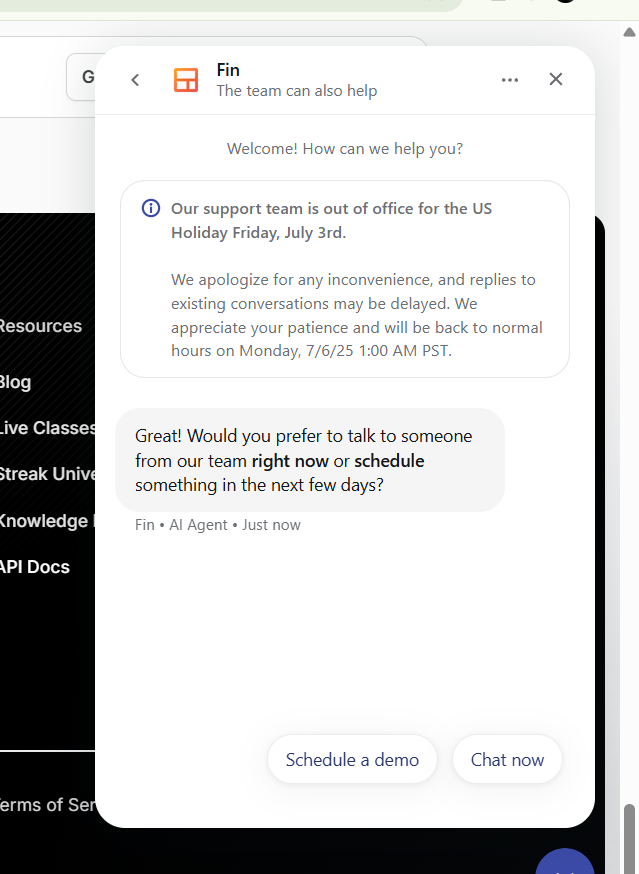
Streak also creates multiple paths toward conversion. Visitors ready to explore independently can start using the product, while higher-intent or larger buyers can request a demo or interact with the website’s conversational support experience.
The primary opportunity lies in proof rather than clarity.
Streak prominently displays its Chrome Web Store rating, Google partnership recognition, and user numbers. However, the website appears to rely less heavily on detailed customer stories, quantified business outcomes, and before-and-after evidence.
Overall assessment: Streak demonstrates how strong positioning, consistent messaging, and product-led onboarding can create a low-friction SaaS buying journey. The next conversion opportunity is to complement that clarity with stronger evidence of customer results.
Hero Section: Immediate Product Clarity
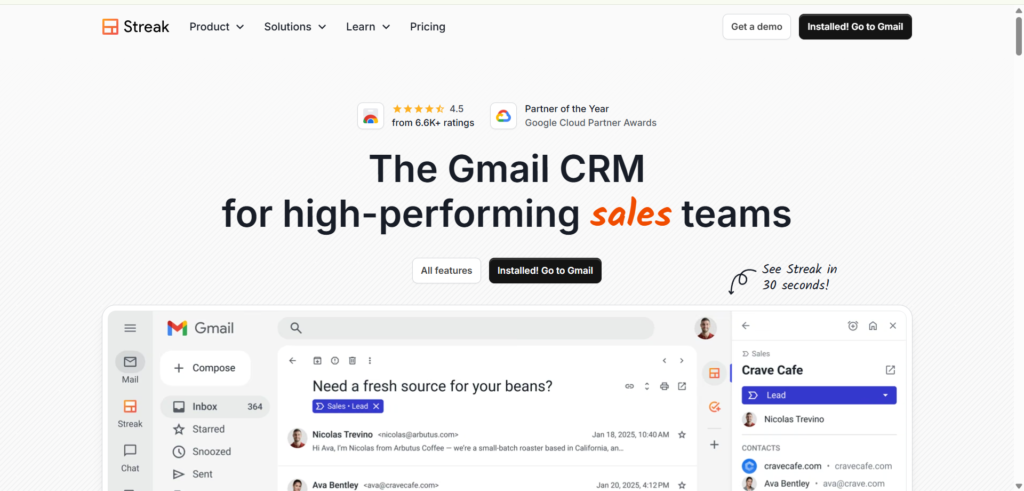
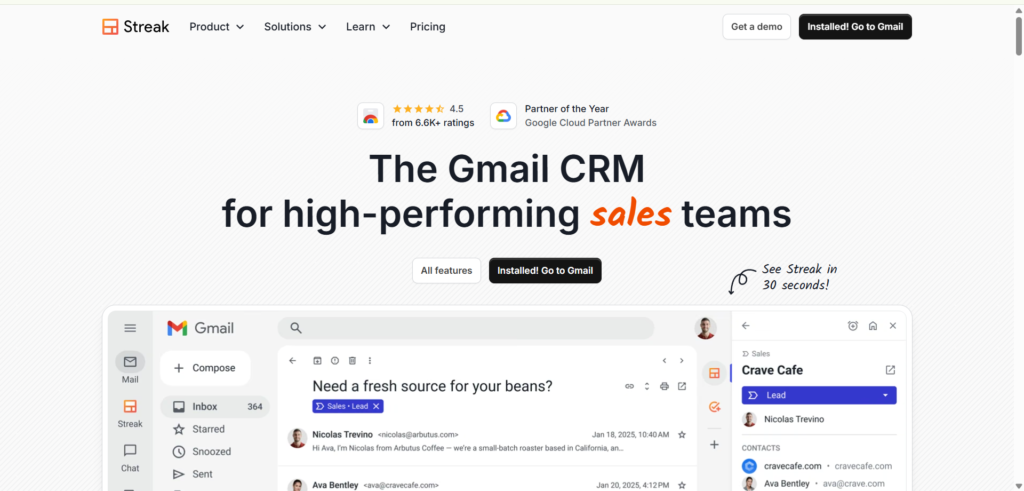
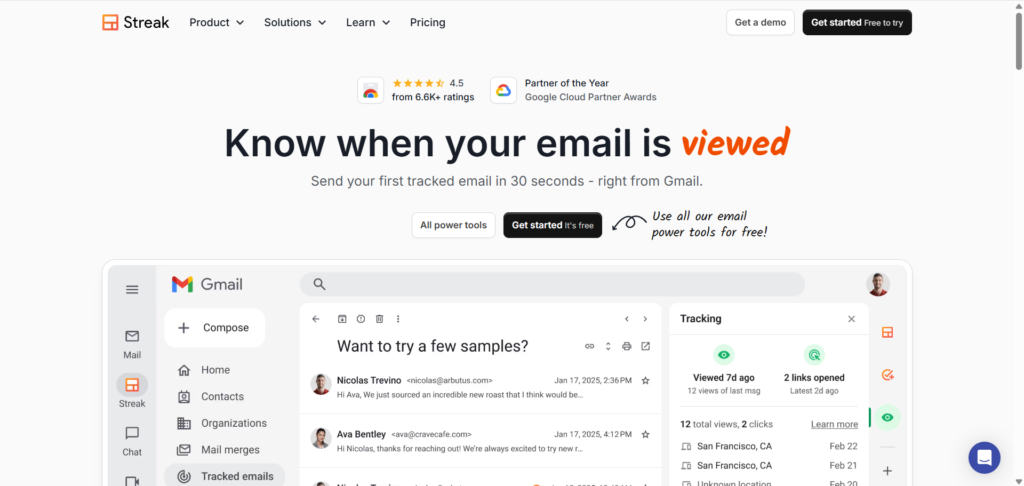
Streak’s homepage hero communicates the product with unusual efficiency.
The headline, “The Gmail CRM for high-performing sales teams,” immediately establishes three things: what the product is, where it works, and who it is designed for.
This clarity is strengthened by the product visual directly below the CTA. Rather than relying on an abstract illustration or generic dashboard screenshot, Streak shows the CRM operating inside Gmail. Visitors can immediately connect the promise in the headline with the actual product experience.
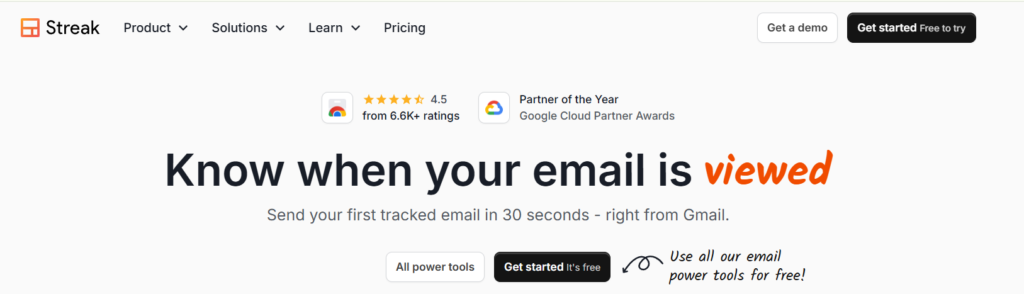
The hero also introduces trust signals before asking visitors to explore further. Its 4.5-star Chrome Web Store rating and Google Cloud Partner recognition help reduce uncertainty, particularly for visitors considering giving a CRM access to an important part of their workflow.
The two CTAs “All features” and “Get started Free to try” support different levels of buying intent. Visitors who need more information can continue exploring, while those already convinced can move directly toward the product.
What works
The hero succeeds because it answers the visitor’s most immediate questions without requiring them to scroll:
What is this? Who is it for? Where does it work? Can I trust it? What should I do next?
Conversion opportunity
The positioning is clear, but the headline emphasizes the product category more than the customer outcome.
“High-performing sales teams” identifies the audience, but a stronger supporting message around the business impact such as reducing CRM administration or keeping sales activity inside the team’s existing workflow could make the value proposition more compelling.
Messaging & Value Proposition: One Core Idea, Repeated Consistently
One of Streak’s strongest messaging decisions is its commitment to a single central idea:
CRM functionality without leaving Gmail.
That idea appears throughout the website in different forms.
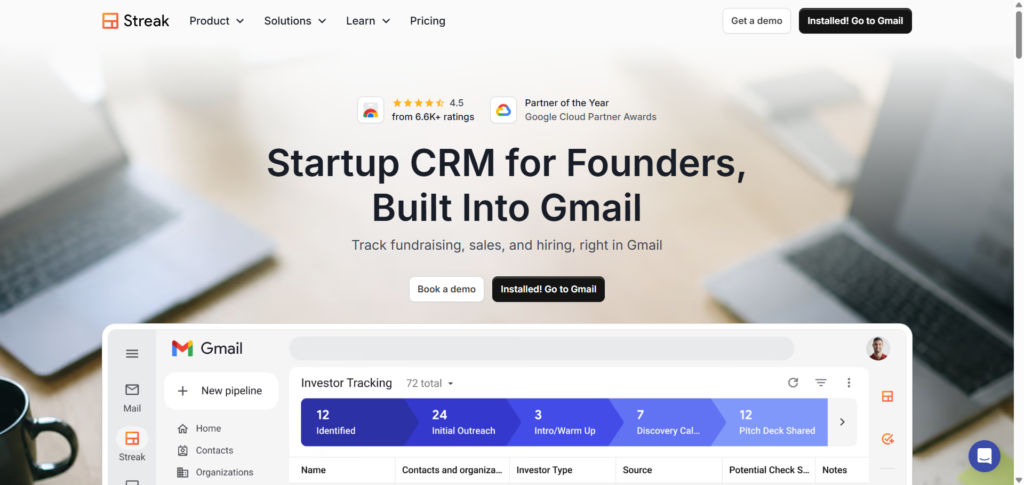
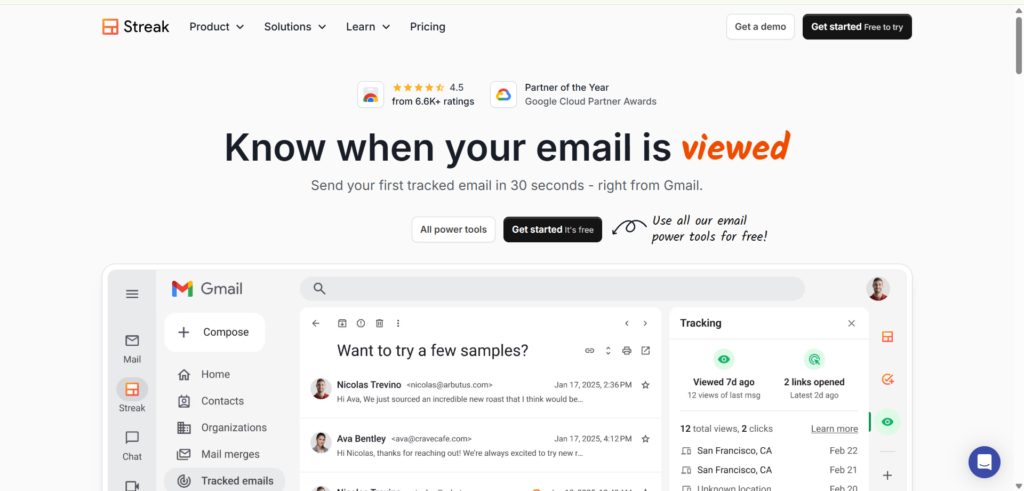
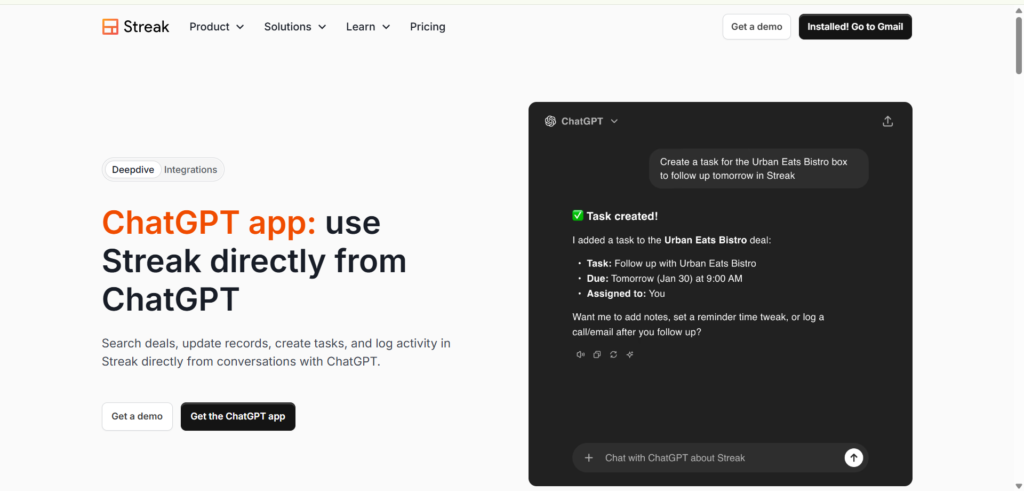
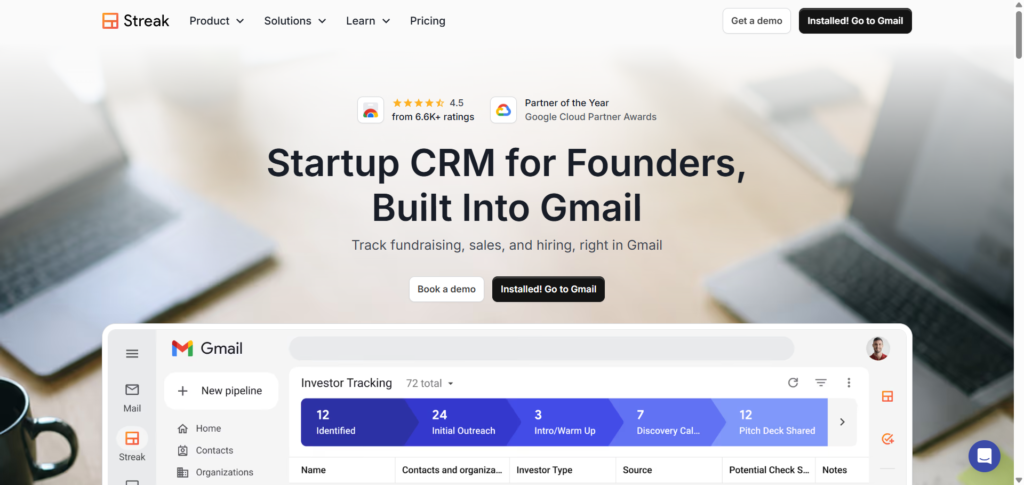
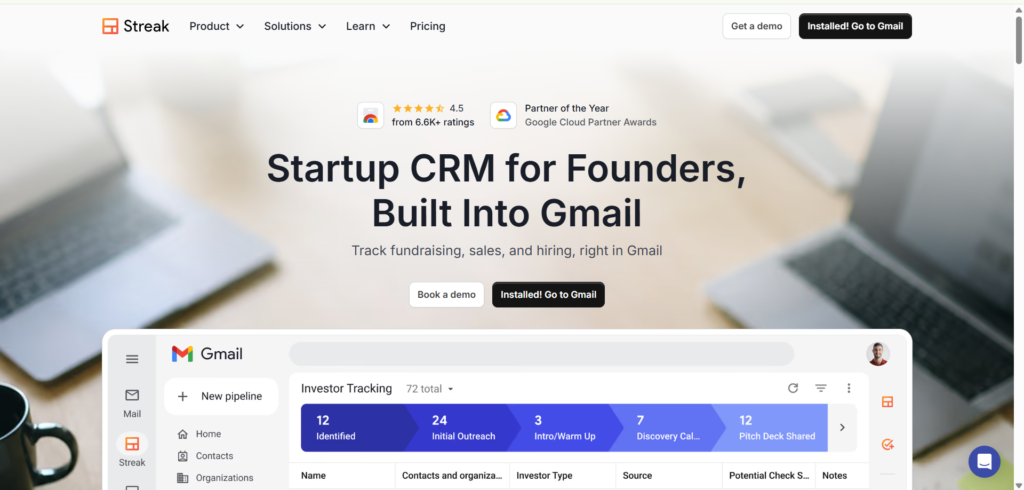
The homepage introduces Streak as “The Gmail CRM.” The startup landing page positions it as “Startup CRM for Founders, Built Into Gmail.” The email tracking page promises users can track emails “right from Gmail.” Even the About page reinforces the company’s belief that the best CRM is one that fits how people already work.
This consistency matters because SaaS websites often introduce different messages across their homepage, feature pages, and audience-specific landing pages. As visitors explore, the product can gradually become harder, not easier to understand.
Streak avoids that problem.
Each page adapts the message to a different use case or audience while maintaining the same underlying product position.
| Page | Primary Message | Role in the Buying Journey |
|---|---|---|
| Homepage | Gmail CRM for sales teams | Establishes the core product category |
| Startup page | CRM for founders built into Gmail | Adapts the product to a specific audience |
| Email tracking page | Know when emails are viewed | Communicates an immediate feature benefit |
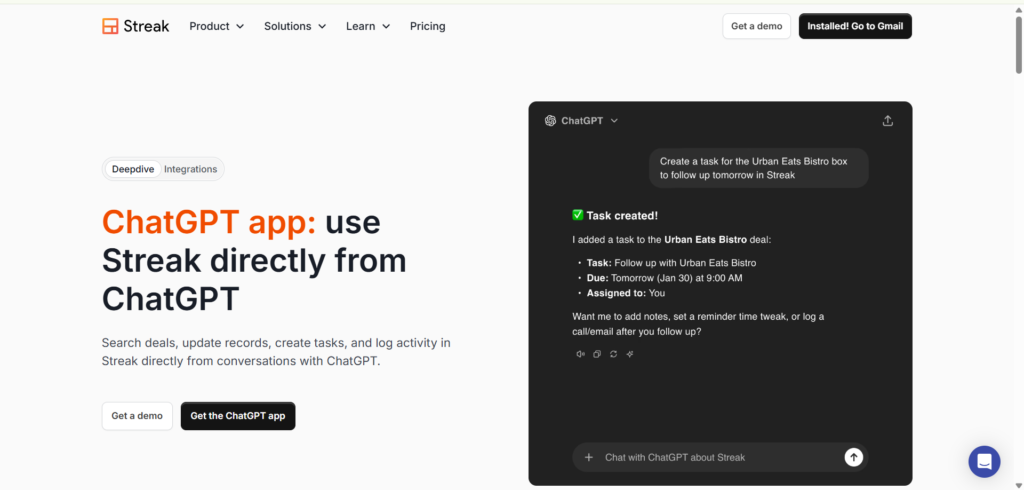
| ChatGPT integration page | Use Streak directly from ChatGPT | Expands the product ecosystem |
| About page | Build a CRM teams will actually use | Reinforces the company’s product philosophy |
What works
Streak demonstrates an important SaaS messaging principle: consistency does not require repeating the exact same headline everywhere.
The company changes the message according to visitor intent while preserving the same core positioning.
A founder, salesperson, or visitor researching a specific feature may enter the website through different pages, but each path leads back to the same understanding of the product.
Conversion opportunity
The messaging explains what makes Streak different extremely well. However, it could communicate what customers achieve because of that difference more prominently.
The next layer of messaging could connect the Gmail-native experience to measurable outcomes: faster CRM adoption, less manual data entry, fewer missed follow-ups, or more time spent selling.
Product Positioning: The Website and Product Deliver the Same Promise
Streak’s strongest positioning advantage becomes even clearer after entering the product.
Many SaaS websites promise simplicity, speed, or ease of use. The actual product experience can tell a different story: visitors sign up, enter an unfamiliar dashboard, and immediately face another learning curve.
Streak’s website-to-product journey is different.
The website repeatedly promises a CRM that works inside Gmail. After signup, that is exactly what the user encounters.
The Streak interface appears directly within the familiar Gmail environment. Pipelines, tracked emails, contacts, and other CRM functionality become part of the workspace users already understand.
This creates strong message-product alignment.
The positioning is not simply a marketing claim used to differentiate Streak from other CRM platforms. It is reinforced by the actual user experience.
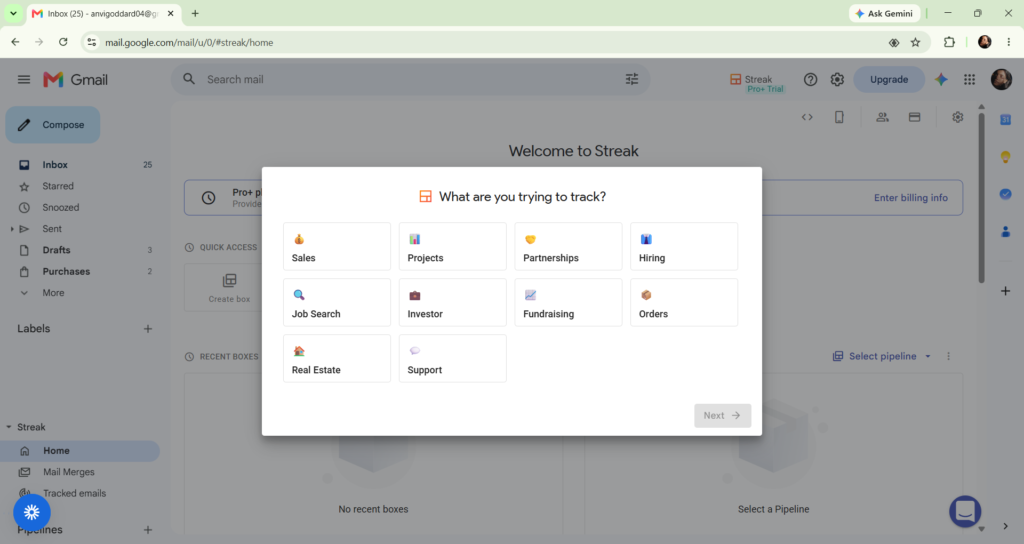
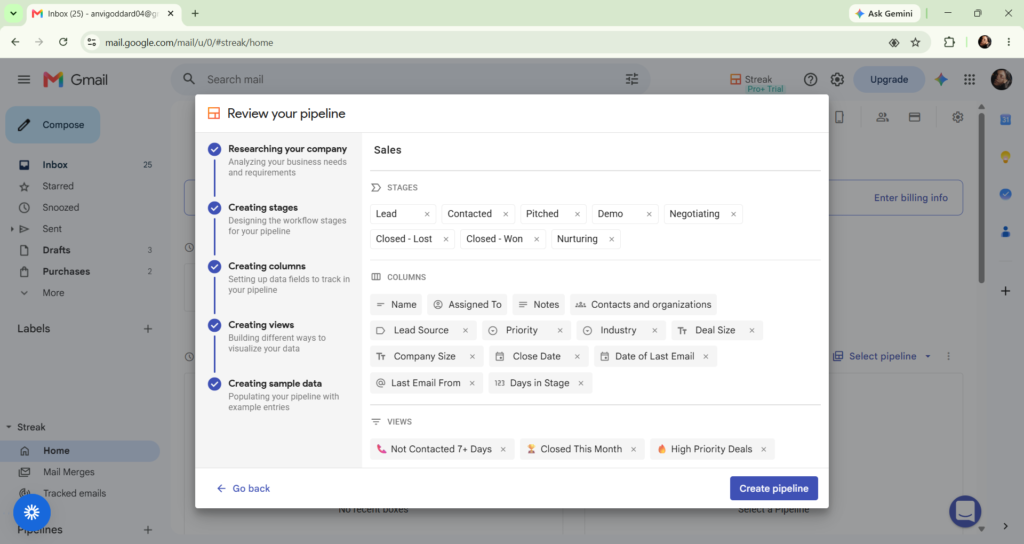
The onboarding flow strengthens this further. Instead of forcing every new user through the same generic setup process, Streak asks what they want to track sales, projects, partnerships, hiring, fundraising, and other workflows.
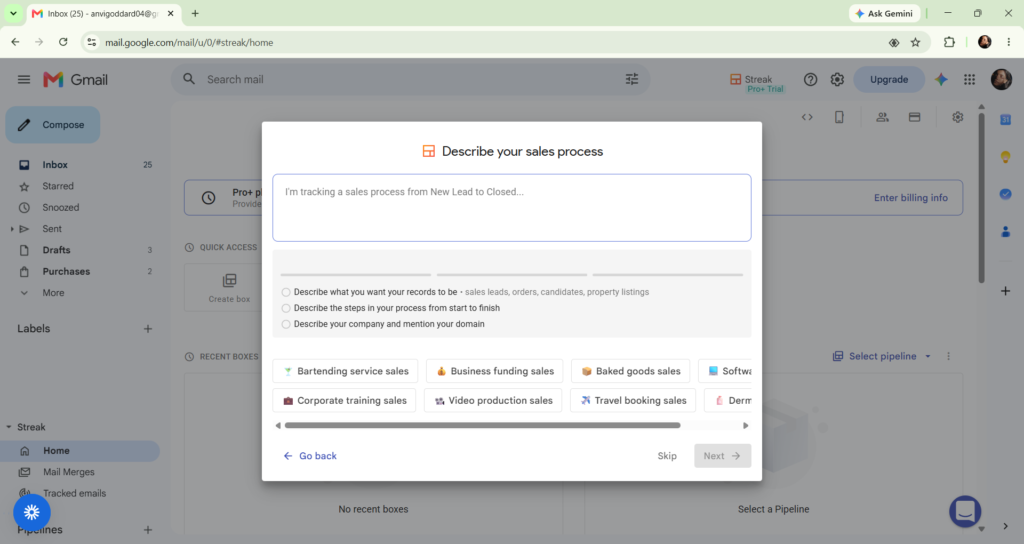
Users can then describe their sales process, and Streak generates relevant pipeline stages, columns, and views.
This moves the experience from:
“Here is our CRM. Learn how to use it.”
to:
“Tell us how you work. We’ll help configure the CRM around you.”
What works
Streak creates continuity across the entire journey:
Website promise → Signup → Gmail environment → Personalized setup → Working pipeline
Reducing the disconnect between marketing and product experience can be especially important for CRM software, where perceived complexity and implementation effort can become significant barriers to adoption.
Conversion opportunity
This product experience is one of Streak’s strongest differentiators, but the website could demonstrate it more explicitly.
Showing more of the transition from signup to personalized pipeline creation could help prospective users understand how quickly they can move from exploring the website to using a CRM configured around their workflow.
A short visual sequence or interactive demonstration of the onboarding process could make the “built into Gmail” promise even more tangible before signup.
Audience Segmentation: One Product, Multiple Buying Journeys
One of the strongest aspects of Streak’s website is how it adapts its messaging without changing its positioning.
Instead of expecting every visitor to relate to the same homepage, Streak creates dedicated landing pages for different audiences and use cases. Startup founders, sales teams, recruiters, customer support teams, and users looking for email tracking all enter the website through pages tailored to their specific needs.
Although the examples and messaging change, the central idea remains consistent:
Manage your work without leaving Gmail.
This balance between personalization and consistency is difficult to achieve. Many SaaS companies create audience pages that feel disconnected from the rest of the website, resulting in inconsistent positioning and unnecessary cognitive load.
Streak avoids that problem.
Every landing page reinforces the same product philosophy while adapting examples, workflows, and language to match the visitor’s context.
What Works
✔ Audience-specific messaging
✔ Consistent positioning across all pages
✔ Different entry points for different search intents
✔ Strong support for SEO and paid acquisition
Conversion Opportunity
The audience pages communicate different workflows effectively, but they rely more heavily on product capabilities than customer outcomes.
Including customer examples or measurable results for each audience would make these pages even more persuasive.
💡 Conversion Analyst’s Note
Personalized landing pages are most effective when they answer:
“How does this product help someone like me?”
Streak answers that question through relevant examples while preserving a consistent brand message across the entire website.
Product Demonstration: Showing Instead of Telling
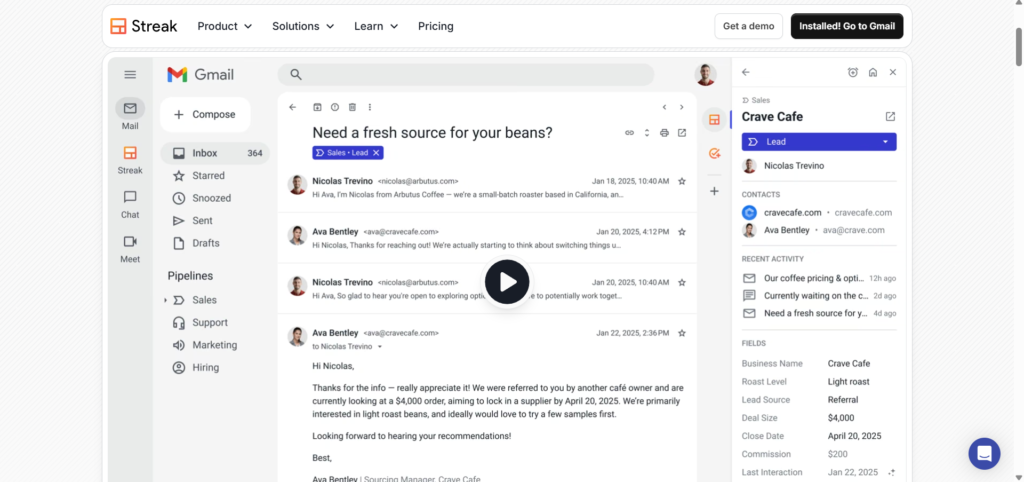
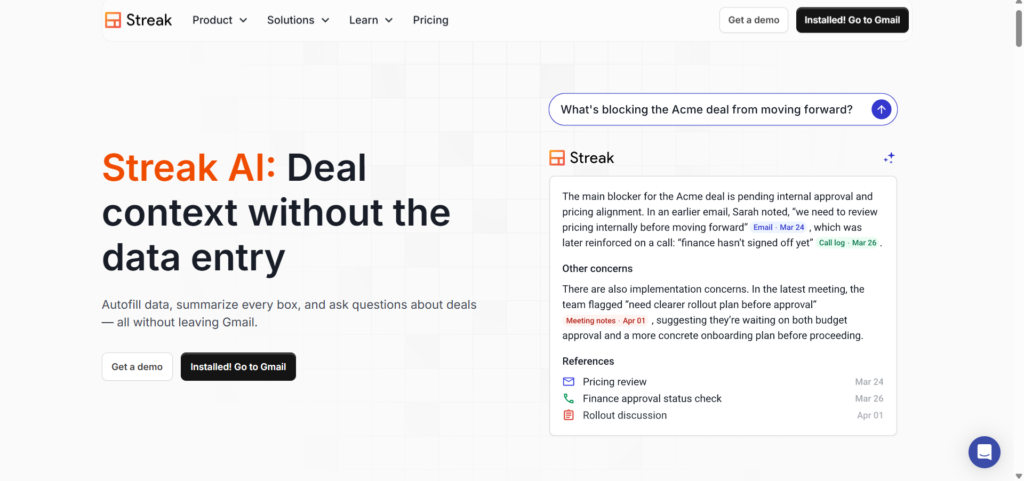
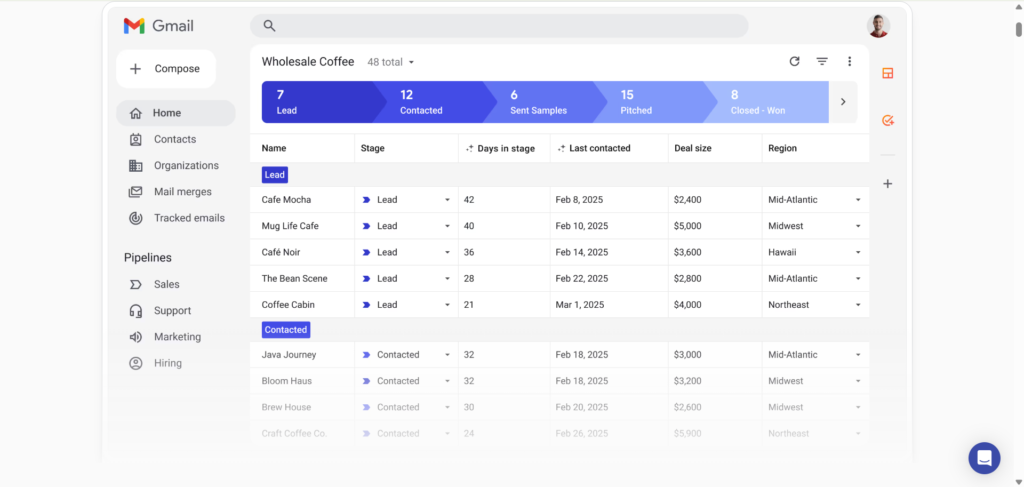
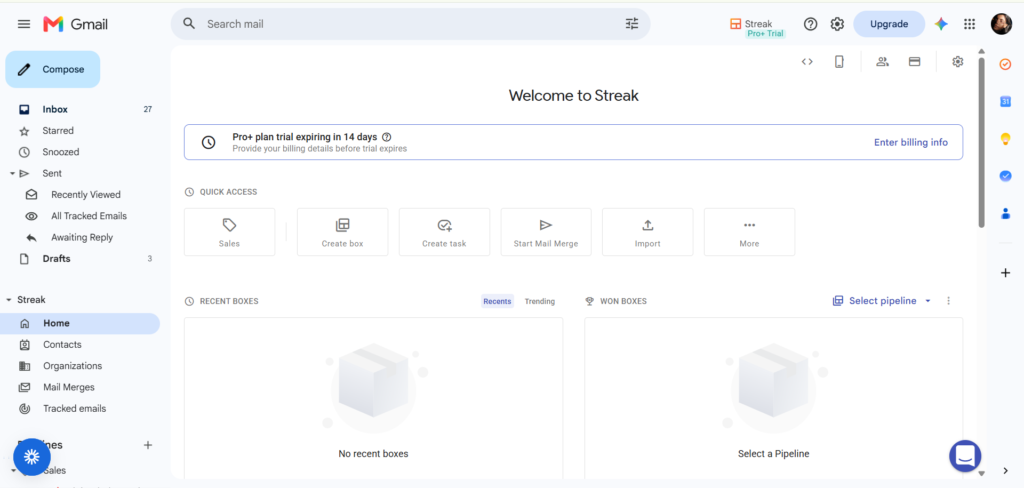
One of Streak’s biggest conversion strengths is how frequently it demonstrates the product.
Almost every major section of the website is supported by product screenshots, animations, or interface previews. Instead of asking visitors to imagine how the CRM works, Streak consistently shows the experience inside Gmail.
This approach significantly reduces uncertainty during the evaluation process.
Visitors can see pipelines, email tracking, AI assistance, contact management, and workflow automation before creating an account. The product itself becomes the primary sales asset.
The Chrome Extension pages reinforce this further by showing how the product integrates directly into Gmail rather than existing as a separate platform.
Another strength is the gradual introduction of complexity.
Rather than overwhelming visitors with every capability at once, the website introduces new features progressively as users continue exploring.
What Works
✔ Real product screenshots throughout the website
✔ Workflow demonstrations instead of abstract illustrations
✔ Strong visual consistency
✔ Product reinforces the messaging
Conversion Opportunity
The demonstrations are excellent, but they remain largely passive.
Adding interactive product tours or guided walkthroughs would allow visitors to experience key workflows before signing up, reducing hesitation even further.
💡 Conversion Analyst’s Note
Every screenshot should answer one question:
“Can I picture myself using this?”
Streak succeeds because visitors rarely have to imagine the product, it is consistently demonstrated throughout the buying journey.
Trust & Credibility: Building Confidence Before Conversion


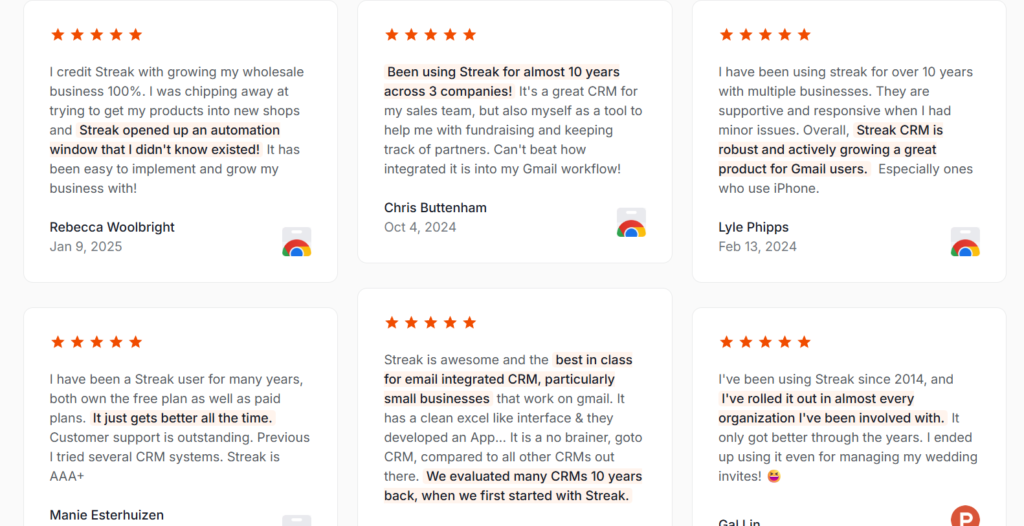
Trust is reinforced consistently throughout Streak’s website.
Rather than relying on a single testimonial section, the company builds confidence through multiple independent trust signals.
Visitors quickly encounter a strong Chrome Web Store rating, thousands of reviews, Google Cloud Partner recognition, and evidence of long-term market presence. These signals help reduce perceived risk before visitors evaluate pricing or begin a trial.
The About page strengthens this credibility by highlighting Streak’s history, profitability, and product philosophy. Instead of focusing solely on company milestones, it reinforces the idea that the product has been intentionally designed around existing workflows since its launch.
The Chrome Web Store serves as another powerful source of social proof. Thousands of reviews and a large installed user base provide independent validation that complements the website’s own messaging.
What Works
✔ Independent third-party credibility
✔ Large installed user base
✔ Strong product reputation
✔ Long-term market presence
✔ Consistent trust signals throughout the website
Conversion Opportunity
While Streak excels at platform credibility, it places less emphasis on customer success stories.
Detailed case studies, measurable business outcomes, or customer transformation stories would complement existing trust signals by showing not only that customers use the product, but the results they achieve because of it.
💡 Conversion Analyst’s Note
Trust is built through three kinds of evidence:
- Platform trust (ratings, reviews, Google partnership)
- Company trust (history, team, longevity)
- Customer trust (case studies, measurable outcomes)
Streak performs exceptionally well in the first two categories. Expanding customer evidence would make the buying journey even more convincing, particularly for decision-makers comparing multiple CRM solutions.
Pricing Strategy: Reducing Buying Friction
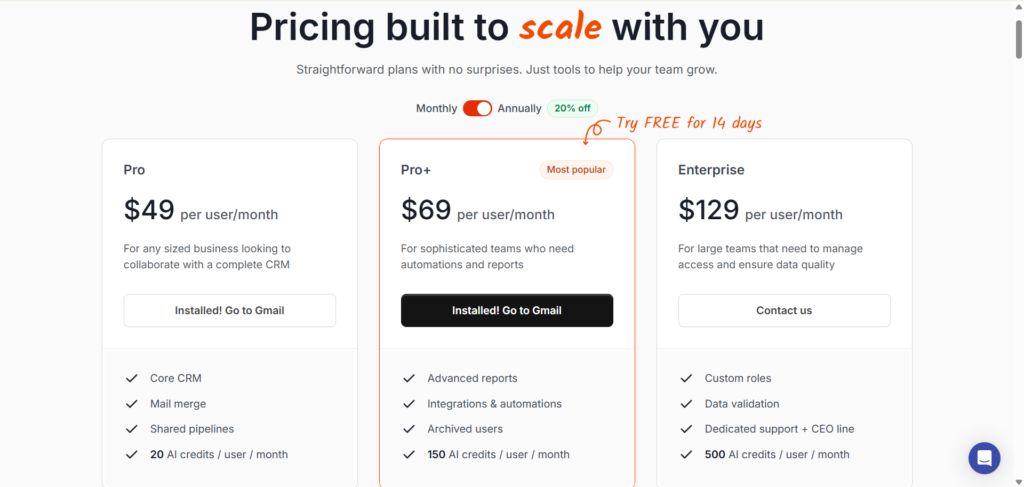
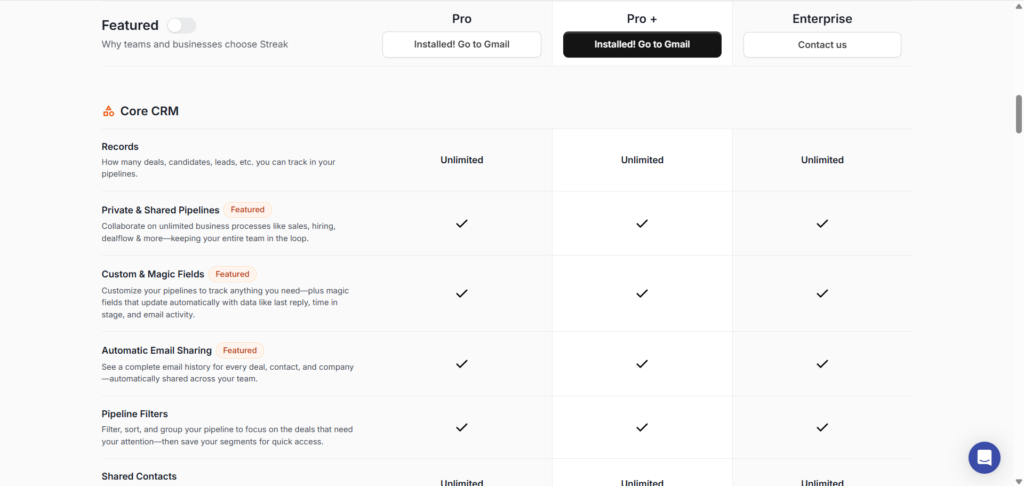
One of Streak’s strongest conversion assets is its pricing page.
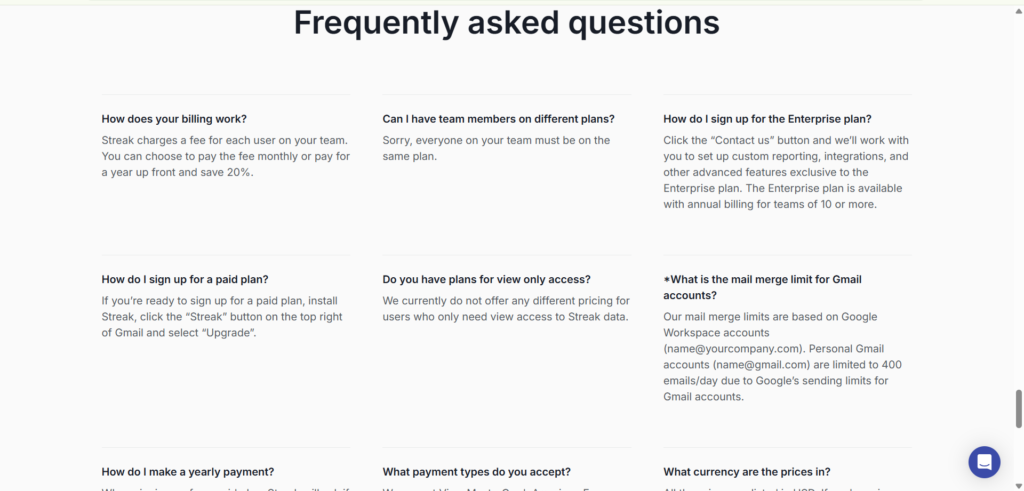
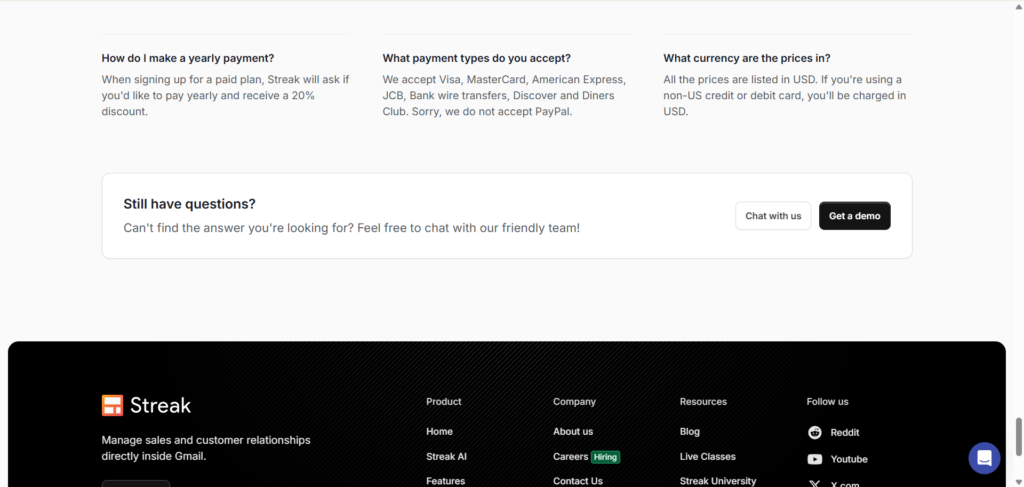
Instead of simply displaying subscription tiers, the page is structured to answer the questions buyers naturally ask before committing to a CRM. Visitors can compare plans, understand feature differences, review common objections through the FAQ section, and choose the option that best matches their needs.
The feature comparison table is particularly effective because it reduces uncertainty. Rather than forcing buyers to open multiple tabs or search documentation, Streak presents the differences between plans in one place.
The page also ends with a strong closing CTA. Unlike the homepage, which concludes without a dedicated conversion-focused footer section, the pricing page gives visitors one final opportunity to take action after reviewing pricing and features.
What Works
✔ Clear pricing hierarchy
✔ Detailed feature comparison
✔ FAQ addresses common objections
✔ Enterprise option for larger teams
✔ Strong closing CTA
Conversion Opportunity
While the pricing structure is easy to understand, the plans focus primarily on feature availability.
Adding short outcome-oriented descriptions for example, identifying which plan is best for growing sales teams, startups, or larger organizations could make plan selection feel even easier.
Similarly, reinforcing customer outcomes or ROI near the pricing section would strengthen buying confidence immediately before conversion.
💡 Conversion Analyst’s Note
A pricing page isn’t just where buyers compare costs.
It’s where they decide whether the expected value justifies the investment.
Streak removes much of the uncertainty through comparison tables and FAQs, but could strengthen the decision even further by connecting pricing to customer outcomes rather than feature access alone.
Conversion Paths & Calls-to-Action

One of Streak’s strengths is that it doesn’t assume every visitor is ready to convert in the same way.
Instead, the website provides multiple paths depending on purchase intent.
Visitors who are ready to explore independently can start using the product through the free trial. Those with more complex questions can book a demo or engage with the website’s conversational support.
This flexibility allows self-serve users and enterprise buyers to follow journeys that match their level of commitment.
The CTA language also remains consistent throughout the website. Rather than introducing different primary actions on every page, Streak repeatedly encourages visitors to either explore the product or begin using it.
One interesting observation is that the homepage ends without a dedicated conversion-focused closing section. The pricing page, however, includes a stronger final CTA that gives visitors another opportunity to act after consuming the content.
Introducing a similar closing section on the homepage could capture additional high-intent visitors before they leave the page.
What Works
✔ Multiple conversion paths
✔ Consistent CTA hierarchy
✔ Self-serve and sales-assisted journeys
✔ Conversational support
Conversion Opportunity
A homepage footer CTA similar to the pricing page would create one final conversion opportunity after visitors complete the homepage journey.
This would be particularly valuable for visitors who reach the end of the page already convinced but without an obvious next step.
💡 Conversion Analyst’s Note
The best websites don’t rely on a single button.
They create multiple opportunities for visitors to convert as confidence increases.
Streak does this well throughout the website, but the homepage could close the journey more deliberately.
Product Onboarding & Activation
Many SaaS websites promise a simple product experience but introduce unnecessary complexity immediately after signup.
Streak takes a different approach.
Rather than presenting users with an empty CRM, the onboarding experience begins by understanding what the visitor wants to accomplish.
Users select the type of work they want to manage, describe their sales or operational process, and receive a personalized pipeline configured around their workflow.
This onboarding reinforces the positioning introduced throughout the website.
Instead of asking users to adapt to the software, the software begins adapting to the user.
The Gmail integration further strengthens this experience. New users continue working inside an interface they already understand rather than learning an entirely separate platform from scratch.
This continuity between website messaging and product experience reduces activation friction and increases the likelihood that new users reach their first successful outcome.
What Works
✔ Personalized onboarding
✔ Workflow-based setup
✔ Strong message-product alignment
✔ Familiar Gmail environment
✔ Reduced learning curve
Conversion Opportunity
The onboarding experience is one of Streak’s strongest differentiators, but much of it is only visible after signup.
Bringing more of this experience into the marketing website through an interactive walkthrough or short onboarding preview could reduce uncertainty and increase trial starts by showing visitors exactly how quickly they can become productive.
💡 Conversion Analyst’s Note
One of the biggest reasons SaaS trials fail is that visitors don’t know what happens after clicking “Get Started.”
Streak removes much of that uncertainty through guided onboarding and a familiar Gmail interface.
Making more of that experience visible before signup could strengthen one of the website’s most compelling competitive advantages.
Content Strategy & Organic Growth
One of Streak’s less obvious strengths is its content strategy.
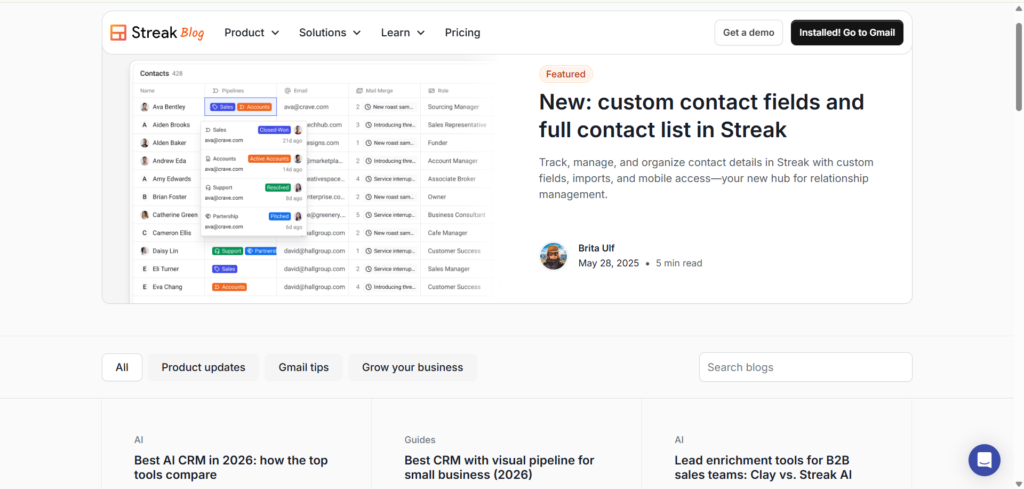
Rather than relying solely on a traditional blog, the website combines educational articles with audience-specific landing pages and feature-focused content. This approach allows visitors to discover the product from multiple entry points depending on what they are searching for.
For example, someone researching email tracking, CRM software for startups, or AI-powered CRM workflows can enter the website through dedicated pages tailored to those interests.
This strategy supports both organic search visibility and buyer education.
Instead of directing every visitor to the homepage, Streak creates multiple opportunities for prospective customers to understand the product within the context of their own workflows.
The blog itself also supports this approach by publishing practical content around CRM workflows, sales productivity, AI, and customer relationship management rather than focusing exclusively on product announcements.
What Works
✔ Multiple entry points into the website
✔ Strong search intent alignment
✔ Educational content supports product discovery
✔ Feature pages contribute to SEO
✔ Industry-specific pages strengthen relevance
Conversion Opportunity
The content ecosystem is strong, but there are relatively few customer success stories integrated into it.
Adding detailed case studies, customer interviews, or measurable business outcomes would help bridge the gap between education and purchase confidence.
💡 Conversion Analyst’s Note
Content should do more than attract visitors.
It should prepare them to make better buying decisions.
Streak’s content ecosystem succeeds because it educates visitors before asking them to start a trial.
Biggest Conversion Opportunities
No website is without opportunities, and Streak is no exception. The following recommendations focus on strengthening an already well-executed buying journey rather than redesigning it.
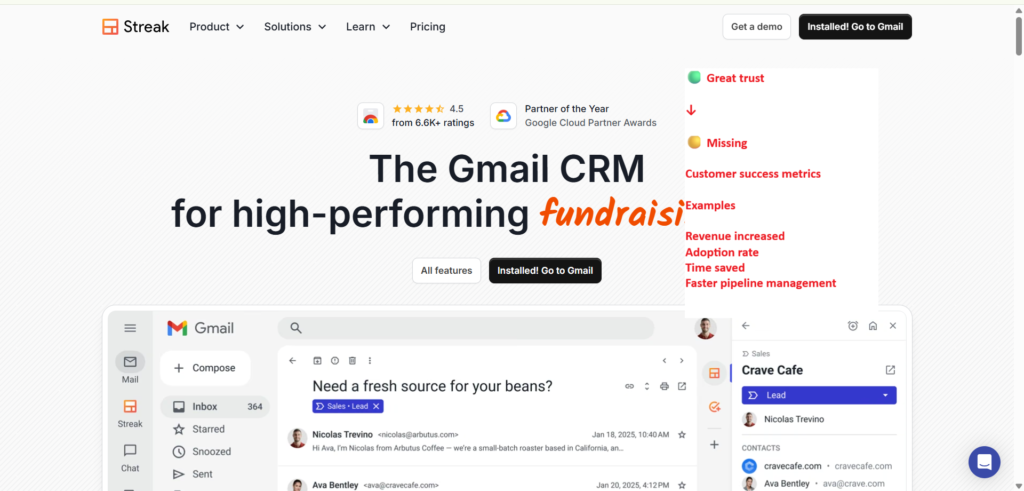
1. Reinforce Customer Outcomes Earlier
Impact: ⭐⭐⭐⭐⭐
Difficulty: ⭐⭐☆☆☆
The website clearly explains where the product works and how it works.
The next step is showing what customers achieve because of it.
Metrics such as time saved, CRM adoption, or productivity improvements would make the value proposition even stronger.
2. Introduce More Customer Stories
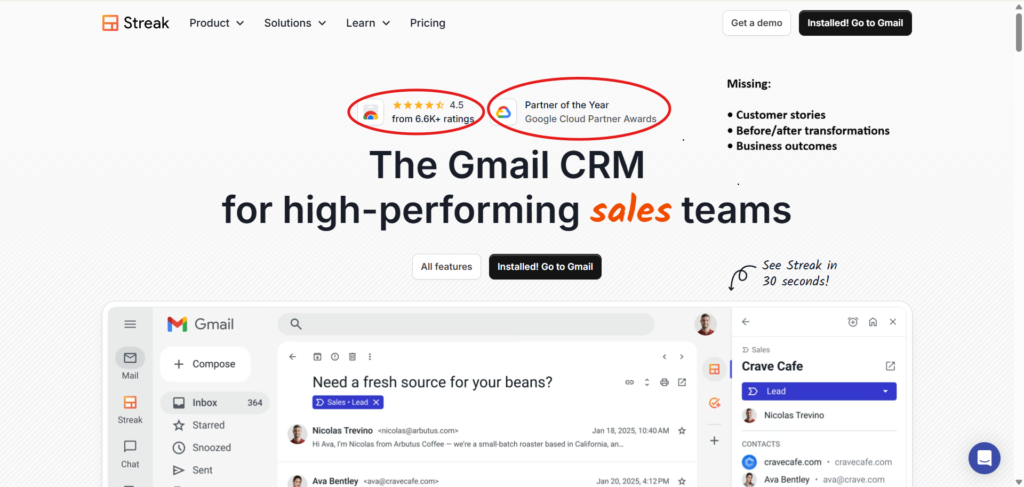
Strong platform credibility, but limited customer success evidence.
Impact: ⭐⭐⭐⭐☆
Difficulty: ⭐⭐⭐☆☆
Ratings and platform recognition establish credibility, but detailed customer stories would demonstrate real-world business impact.
Showing transformation rather than satisfaction would create stronger purchase confidence.
3. Add A Homepage Closing CTA
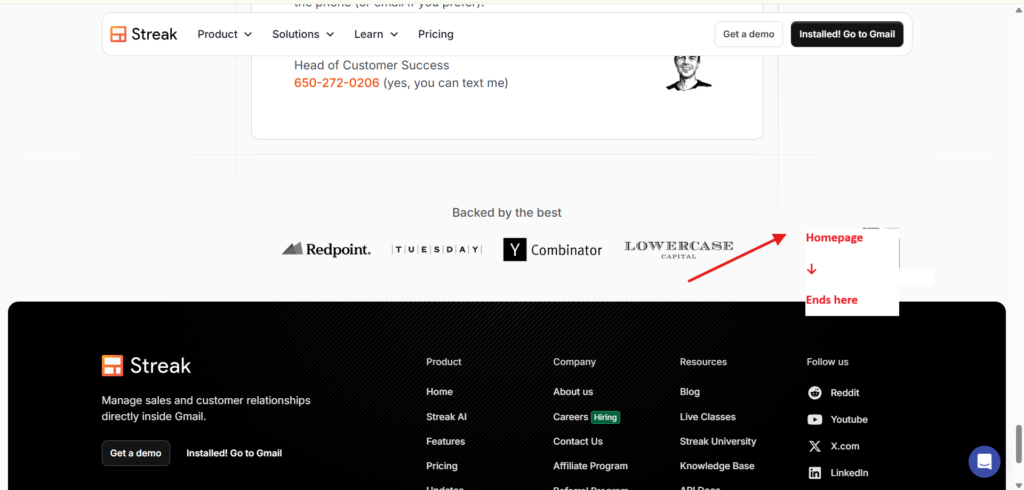
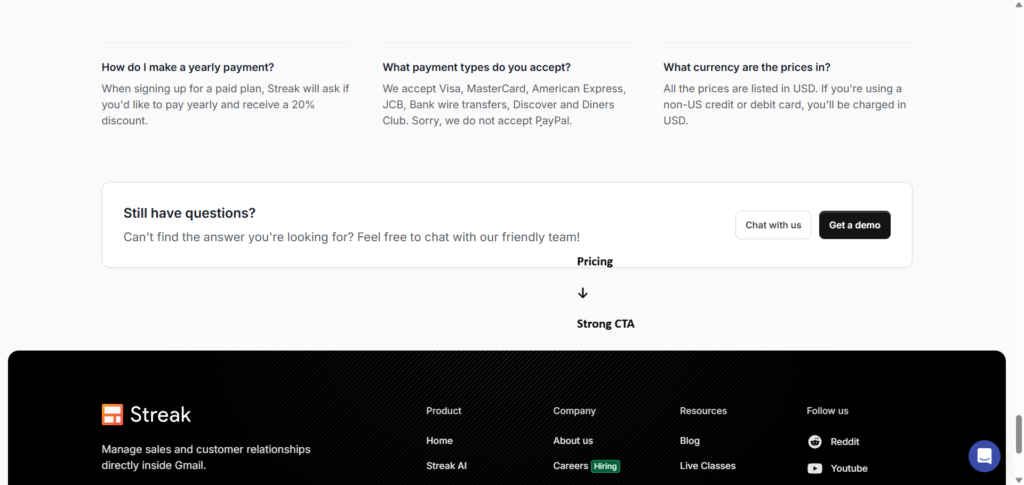
Pricing closes the journey more effectively than the homepage.
Impact: ⭐⭐⭐⭐☆
Difficulty: ⭐☆☆☆☆
Unlike the pricing page, the homepage ends without a dedicated conversion section.
A final CTA could capture visitors who have reached the end of the buying journey and are ready to act.
4. Surface Product Onboarding Earlier
One of Streak’s biggest competitive advantages appears after signup.
Impact: ⭐⭐⭐☆☆
Difficulty: ⭐⭐⭐☆☆
The onboarding experience is one of Streak’s strongest competitive advantages.
Demonstrating more of that experience before signup could reduce hesitation for new users.
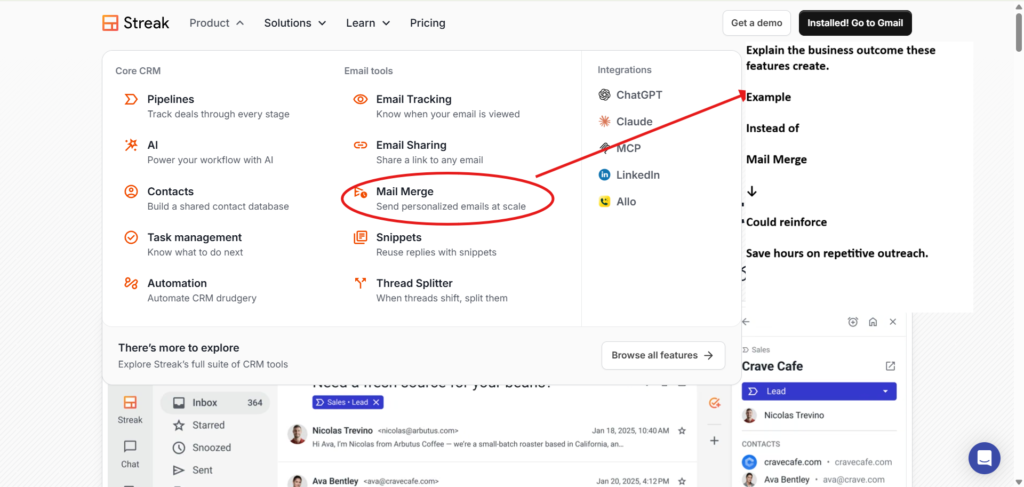
5. Connect Features To Business Results
Impact: ⭐⭐⭐☆☆
Difficulty: ⭐⭐☆☆☆
Many feature pages explain capabilities well.
Reinforcing measurable outcomes alongside those capabilities would strengthen buyer motivation.
Overall Observation
None of these recommendations require fundamental changes to the website.
Instead, they focus on making an already strong buying journey even easier to understand, trust, and act upon.
💡 Conversion Analyst’s Note
The strongest SaaS websites rarely need more features.
They usually need stronger evidence that those features create meaningful business outcomes.
Key Lessons For SaaS Founders
Every teardown in this series ends with practical lessons that other SaaS founders can apply to their own websites.
Streak demonstrates several principles that extend well beyond CRM software.
📦 Lesson 1
Position Around Existing Behaviour
Rather than asking customers to learn an entirely new way of working, Streak positions itself around a tool people already use every day.
Reducing behavioural change often reduces buying friction.
📦 Lesson 2
Consistency Builds Recognition
The website reinforces the same positioning across the homepage, audience pages, feature pages, onboarding, and product experience.
Visitors never need to reinterpret what the product is.
📦 Lesson 3
Show The Product Early
Real product screenshots remove uncertainty more effectively than abstract illustrations.
When visitors can immediately visualize the experience, they gain confidence faster.
📦 Lesson 4
Create Multiple Entry Points
Different buyers search in different ways.
Audience pages, feature pages, and educational content allow more visitors to discover the product from the context that matters most to them.
📦 Lesson 5
Make Marketing Match The Product
One of Streak’s biggest strengths is that the experience after signup reinforces the promises made before signup.
Consistency between marketing and product builds trust and reduces disappointment.
Final Observation
Streak demonstrates that conversion isn’t created by a single landing page or CTA.
It comes from maintaining a clear promise across every stage of the customer journey, from the first website visit to the first successful product experience.
💡 Conversion Analyst’s Note
One principle stood out more than any other while analyzing Streak:
The best positioning doesn’t just describe your product, it shapes the entire experience around how your customers already work.
That’s exactly what Streak achieves by building its CRM inside Gmail rather than asking users to adapt to an entirely new environment.
Overall Website Evaluation
| Category | Score |
|---|---|
| Messaging & Positioning | 9.8 / 10 |
| Product Demonstration | 9.9 / 10 |
| Navigation & UX | 9.5 / 10 |
| Trust & Credibility | 9.2 / 10 |
| Pricing Experience | 9.6 / 10 |
| Content Strategy | 9.4 / 10 |
| Conversion Journey | 9.3 / 10 |
⭐ Overall Rating
9.5 / 10
Final Verdict
Streak demonstrates how a SaaS company can build an entire buying journey around one simple positioning idea.
Rather than competing by adding more features or increasingly complex messaging, the website repeatedly reinforces the same promise: your CRM should work where your team already works.
That consistency extends beyond the homepage into feature pages, pricing, onboarding, industry-specific landing pages, and even the product itself.
The result is a website that feels coherent from the first click to the first product interaction.
While there are opportunities to strengthen customer proof and business outcome messaging, these are refinements rather than fundamental weaknesses.
For SaaS founders, Streak is an excellent example of how consistent positioning can simplify the buying journey without oversimplifying the product.
Would I Recommend Studying This Website?
Absolutely.
Streak is one of the strongest examples of positioning consistency we’ve reviewed so far.
What makes it worth studying isn’t just the visual design or polished interface.
It’s how every major page reinforces the same idea while gradually reducing uncertainty throughout the buying journey.
If I were building a SaaS website today, I’d borrow these ideas:
✅ Build your positioning around an existing customer behaviour rather than asking people to learn a new one.
✅ Demonstrate the product instead of describing it.
✅ Keep messaging consistent across homepage, feature pages, onboarding, and product experience.
✅ Create dedicated landing pages for different audiences while preserving one clear value proposition.
✅ Let the product itself become one of your strongest conversion assets.
Wondering How Your Website Compares?
Every SaaS website guides buyers through a series of decisions.
Some pages build confidence.
Others create uncertainty without anyone realizing it.
A Website Conversion Breakdown identifies where visitors gain clarity, where they hesitate, and what changes could help your website convert more qualified buyers.